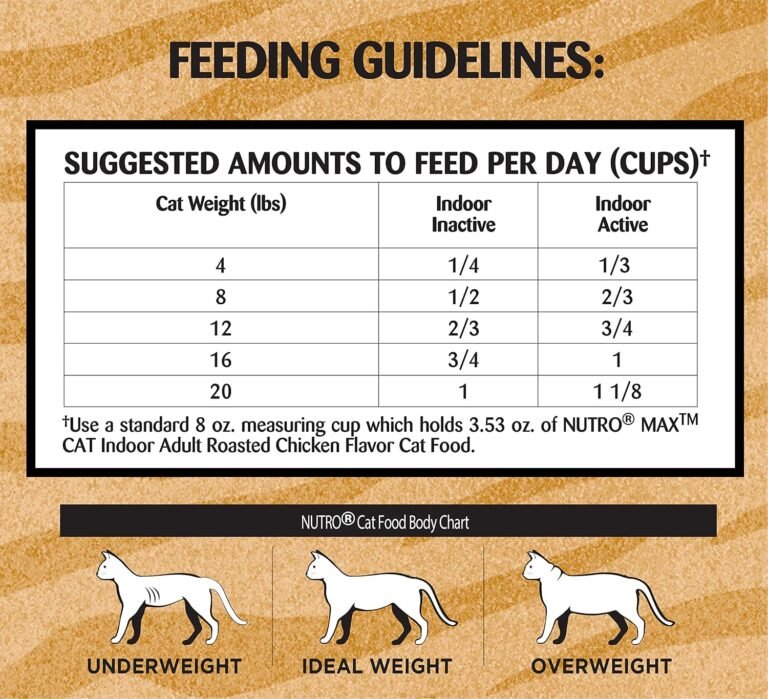
Most adult cats need a measured daily portion based on their ideal weight, activity, age, and the calories in their food. Many average-sized adult cats need roughly 200 to 300 calories a day, but individual needs can fall outside this range. Check the food label, measure each serving, and adjust the amount to maintain a healthy body condition.
If you share your home with a cat in the United States, you may be used to filling a bowl before work and topping it up when you get home. Dry food is easy to store and serve, but a bowl that stays full can make it hard to tell how much your cat actually eats. Even a small daily excess can add up over time.
The best way to decide how much dry food to feed your cat is to start with daily calorie needs, convert those calories into a measured portion, and then watch your cat’s weight and body shape. Indoor cats, outdoor cats, growing kittens, older cats, and cats with medical needs may all require different amounts. A feeding chart is a useful starting point, not a rule that fits every cat.
This guide explains how to read a cat food label, estimate portions, split meals, and spot signs that your feeding plan needs a change. It offers general guidance rather than a personalized veterinary prescription. If your cat has a medical condition, is losing weight without reason, or needs a major weight change, ask your veterinarian for an individual feeding plan.
Source: marriedceleb.com
How Much Dry Food Should My Cat Eat Each Day?
The right daily amount is the portion that supplies enough energy and nutrients while helping your cat maintain a healthy body condition. For many healthy adult cats, a rough starting point is about 200 to 300 calories per day. A small, calm indoor cat may need less, while a larger or more active cat may need more.
Calories are a better guide than cup counts alone. One brand may contain 300 calories per cup, while another may contain 450 or more. Feeding the same volume of both foods would not give your cat the same amount of energy.
Start with the feeding instructions on your cat’s food package and the calorie information printed on the label. These instructions usually use body weight or a weight range. They may not fully account for your cat’s age, neuter status, activity, health, or ideal body weight, so treat them as a starting estimate.
If your cat eats both dry and wet food, do not feed a full dry-food allowance and then add a full wet-food allowance. Both foods contribute calories. Set one daily calorie budget and divide it between all meals, treats, and extras.
Source: cdn.liverampup.com
Small adult cat
A smaller cat may need a lower daily calorie intake than a large cat. Use the cat’s ideal weight and the food label rather than guessing from bowl size.
Average-sized adult cat
A rough estimate of 200 to 300 calories per day can help with initial planning, but it is not a universal prescription.
Large or active adult cat
A larger or more active cat may need more energy, although body frame and activity matter more than weight alone.
Cat that needs to lose weight
Use a veterinarian-approved calorie target based on ideal weight and health. Do not sharply reduce food without guidance.
Why There Is No Single Correct Portion
Two cats that weigh the same may have different calorie needs. One may spend much of the day resting, while the other climbs, plays, and runs around the home. Age, muscle mass, neuter status, temperature, and health can also affect energy use.
Current weight is not always the right weight to use. If your cat is overweight, calculating a full daily portion from its current weight may provide more calories than needed. Your veterinarian can help estimate a suitable target weight and safe rate of weight loss.
Look at body condition
You should generally be able to feel the ribs under a thin layer of fat, see a waist from above, and notice a slight abdominal tuck from the side.
Recheck after changes
Reassess the portion when your cat’s activity, age, health, food, or weight changes.
How to Calculate Your Cat’s Dry Food Portion
You can estimate a daily dry-food portion with two numbers: your cat’s daily calorie target and the food’s calories per cup or gram. This turns a broad feeding recommendation into a practical amount you can measure at home.
First, find the calorie statement on the package. It may say kilocalories per cup, kilocalories per kilogram, or kilocalories per kilogram of food. In pet food, a Calorie with a capital C means a kilocalorie, which is the unit used for daily feeding calculations.
Next, choose a daily calorie target. For a healthy adult cat, use the package guide as your starting point and ask your veterinarian if you are unsure. A cat that needs to gain or lose weight, or has a health condition, may need a different target.
Divide the daily calorie target by the calories in one cup to find the number of cups for a full day. If the label lists calories per gram instead, divide the daily target by that figure to get the daily weight of food.
Source: static1.srcdn.com
Step 1: Read the label
Find the calorie content and feeding guide for the exact food you use.
Step 2: Set a daily calorie target
Use the package guide as an initial estimate for a healthy adult cat and seek veterinary advice for special needs.
Step 3: Divide calories by food density
Daily calorie target divided by calories per cup equals cups per day.
Step 4: Measure the food
Use a measuring cup for convenience or a kitchen scale for more precise portions.
Step 5: Track results
Watch body condition and weight over time, then make small changes if needed.
A Simple Dry Food Calculation Example
Suppose your cat’s estimated daily target is 240 calories and the dry food contains 400 calories per cup. Divide 240 by 400 to get 0.6 cup per day. That is the total for the day, not the amount to serve at every meal.
If you feed three meals, divide 0.6 cup by three. Each meal would contain about 0.2 cup, provided the cat receives no other food. If you also give treats or wet food, subtract their calories from the daily budget before working out the dry portion.
This is a hypothetical example, not a feeding prescription for every 240-calorie cat. The correct target depends on the individual cat, and the calorie density must match the actual food label.
Example calculation
240 calories per day divided by 400 calories per cup equals 0.6 cup per day.
Three meals
0.6 cup divided by three meals equals 0.2 cup per meal before accounting for treats or other food.
Why a Kitchen Scale Can Help
A kitchen scale can make portions more consistent than a scoop. Kibble size and shape affect how tightly pieces settle in a measuring cup, so two scoops that look alike may not weigh exactly the same.
If the package gives calories per kilogram, divide that number by 1,000 to find calories per gram. For example, food with 3,800 calories per kilogram contains 3.8 calories per gram. A hypothetical 240-calorie daily target would equal about 63 grams of that food per day, before subtracting calories from treats or other meals.
Use the actual label values for your food. The figures above explain the method and are not a claim about any particular brand.
Weigh consistently
Use the same scale and container each day to reduce portion variation.
Recalculate after switching food
A new recipe may have a different calorie density, so the old cup or gram amount may no longer be appropriate.
How Much Dry Food Do Cats Need by Age?
Age changes how a cat uses energy, so kittens and adult cats should not automatically receive the same feeding plan. Growing kittens need food that supports development, while many older cats need careful monitoring as activity and health change.
Choose a complete and balanced food labeled for the correct life stage. A kitten food is designed for growth, while an adult maintenance food is designed for adult cats. Follow the package instructions and adjust portions based on growth, body condition, and veterinary advice.
Source: www.imdb.com
Kittens
Growing kittens often need more calories relative to their body weight than adults. They usually do best with several small meals and a complete kitten diet.
Young adult cats
Once growth is complete, use an adult feeding plan and monitor weight as the cat’s activity and metabolism settle.
Middle-aged adults
Measure portions and check body condition regularly. Less activity can make weight gain easier even when appetite seems unchanged.
Senior cats
Older cats may need a different calorie intake or diet because of changes in muscle mass, appetite, teeth, kidneys, or other health issues. Age alone does not determine the right portion.
Feeding Kittens
Kittens grow quickly and have small stomachs, so several meals spread through the day may work better than one or two large servings. The exact number of meals and total amount depend on the kitten’s age, weight, growth, and the food’s energy content.
Check the feeding guide often as the kitten grows. A portion that works at one stage may not meet its needs several weeks later. If a kitten is not growing as expected, has persistent diarrhea, or refuses food, contact a veterinarian rather than simply adding more kibble.
Use kitten food
Choose a complete and balanced diet labeled for growth unless a veterinarian recommends a different diet.
Keep meals consistent
Measure the daily amount and divide it into meals suited to the kitten’s age and routine.
Feeding Adult and Senior Cats
For adult cats, a measured daily portion helps keep energy intake steady. Indoor cats that move little may need fewer calories than active cats, but do not assume that every indoor cat needs the same amount.
For senior cats, watch both fat and muscle. A cat can lose muscle while gaining fat, or lose weight because of an illness. A change in appetite or body weight deserves attention, especially in an older cat.
Monitor muscle and weight
Look for changes along the back, shoulders, hips, and ribs as well as changes on the scale.
Arrange a checkup when needed
Ask your veterinarian about persistent weight loss, increased thirst, vomiting, or a marked change in appetite.
How Indoor Cats, Outdoor Cats, and Neutered Cats Differ
A cat’s lifestyle can affect its energy needs, but lifestyle labels alone do not tell you how much to feed. An indoor cat that plays often may need more food than a sedentary cat of similar size, while an outdoor cat’s needs depend on activity, weather, and access to other food sources.
Cats that have been spayed or neutered may need fewer calories than they did before the procedure. Their appetite and energy use can change, so it is sensible to review the feeding amount instead of continuing the old portion without checking weight.
For cats that roam outdoors, it can be hard to know their total intake. A neighbor may feed them, or they may catch prey. If weight is rising or falling unexpectedly, consider these extra food sources before changing the measured portion sharply.
Source: fity.club
Indoor cats
Use play, climbing spaces, and food puzzles to support activity while keeping the daily portion measured.
Outdoor cats
Consider activity and any food eaten elsewhere. Monitor body condition rather than assuming outdoor access guarantees a healthy weight.
Spayed or neutered cats
Recheck calorie needs after the procedure and adjust the measured amount if body condition changes.
Multi-cat homes
Feed cats separately when possible so you can tell who ate what and prevent one cat from taking another’s portion.
Why Free-Feeding Can Make Portions Hard to Track
Free-feeding means leaving dry food available for a cat to eat throughout the day. Some cats can manage their intake well, but others keep returning to the bowl and eat more than they need.
If you choose free-feeding, measure the full day’s amount first rather than refilling the bowl whenever it looks low. This gives you a clear view of intake and makes it easier to notice a sudden change in appetite.
For cats that gain weight or live with other pets, measured meals may make portion control easier. An automatic feeder can help deliver set amounts at set times, but it cannot decide the right daily calorie target for your cat.
Measure before filling
Set aside the day’s total portion in advance and avoid adding extra food without tracking it.
Track each cat
Separate bowls and supervised meals can reveal changes in appetite and prevent food sharing.
How Often Should You Feed Dry Food?
Many adult cats do well with two or more measured meals per day. The best schedule is one you can follow consistently and that suits your cat’s appetite, health, and behavior.
Feeding several small meals can help some cats cope with hunger between meals. It also lets you check how much each cat eats. If your cat eats too fast, a food puzzle or slow feeder may help, provided the design is safe and the cat can use it comfortably.
Kittens often need more frequent meals than adults because they are growing and have smaller stomachs. Cats with diabetes, digestive problems, or other medical conditions may need a schedule tailored by their veterinarian.
Source: ar.inspiredpencil.com
Two meals daily
Split the daily portion between morning and evening if that suits your cat and household routine.
Three or more meals
Divide the same daily total into smaller portions if your cat seems hungry between meals or benefits from more frequent feeding.
Automatic feeding
Use a feeder to deliver measured portions at set times, and check that it dispenses the right amount.
Fresh water
Keep clean water available at all times. Cats eating dry food still need regular access to water.
Build a Feeding Routine That Works
Pick meal times you can maintain on workdays and weekends. Measure the daily food amount in the morning, then divide it among the planned meals so you do not accidentally serve the full amount more than once.
Keep a simple note of the food served, treats given, and any leftovers. This is especially useful when more than one person feeds the cat. A shared record can prevent the well-meaning extra scoop that slowly pushes calories too high.
Use one daily allowance
All household members should take food and treats from the same measured daily total.
Watch leftovers
Repeatedly uneaten meals may point to overfeeding, food preference, dental pain, or a health problem.
How to Tell If Your Cat Is Eating Too Much or Too Little
Your cat’s body condition and weight trend are more useful than appetite alone. Some cats ask for food even after meeting their needs, while others eat less than expected because of stress, dental pain, nausea, or illness.
Check your cat from above and from the side. A healthy adult cat generally has a visible waist behind the ribs, and you should be able to feel the ribs without pressing through a thick layer of fat. The abdomen should not hang heavily because of excess fat, although some cats have a normal loose flap of skin along the belly.
Weigh your cat regularly when possible and compare the results over time. A pet scale is helpful, but you can also weigh yourself holding the cat and subtract your own weight. This method is less precise, so use the same scale and approach each time.
Do not rely on a single measurement. Coat thickness, body frame, age, and muscle mass can affect appearance. If you are uncertain, ask your veterinarian to assess body condition and set a practical target.
Source: ar.inspiredpencil.com
Possible signs of overfeeding
Gradual weight gain, a less visible waist, ribs that become harder to feel, or reduced willingness to move may indicate excess energy intake.
Possible signs of underfeeding
Unintended weight loss, prominent bones, loss of muscle, or persistent hunger can mean the diet or portion needs review.
Possible signs of illness
Sudden appetite changes, repeated vomiting, unusual thirst, diarrhea, or weight loss despite eating deserve veterinary attention.
What to Do If Your Cat Is Gaining Weight
First, measure everything your cat eats for several days. Check the dry food, treats, table scraps, food puzzles, and any meals provided by other household members. Small extras can add up, particularly when a cat’s daily energy needs are modest.
Compare the actual intake with the label’s feeding guide and your cat’s body condition. If the cat is overweight, ask your veterinarian for a safe calorie target and a weight-monitoring plan. Avoid drastic food cuts, which can leave a cat short of nutrients and may create health risks.
Increase play in short, enjoyable sessions and use part of the measured food allowance for enrichment. Activity can help, but it does not replace appropriate portions.
Audit all food
Record meals, treats, leftovers, and food from other people or pets.
Adjust with guidance
Make measured changes based on body condition and veterinary advice rather than using a sudden crash diet.
What to Do If Your Cat Is Losing Weight
Do not assume that a thinner cat simply needs a bigger scoop. Weight loss can result from inadequate intake, dental pain, digestive problems, parasites, diabetes, kidney disease, or other conditions.
Contact a veterinarian if weight loss is unexplained, continues despite eating, or comes with increased thirst, vomiting, weakness, or a change in behavior. If your cat stops eating, seek prompt veterinary advice; prolonged food refusal can be especially dangerous for cats.
Check intake
Confirm how much food the cat actually eats rather than how much is offered.
Check for other signs
Note thirst, litter box changes, vomiting, stool changes, and shifts in energy.
Dry Food, Wet Food, and Treats: Count Every Calorie
Dry food is energy-dense because it contains relatively little water. Wet food contains much more moisture, so a similar volume of wet food often supplies fewer calories than the same volume of kibble. The exact difference depends on the recipe, so compare calorie labels rather than judging by the size of the serving.
A mixed diet can work well if both foods are appropriate for your cat and the total amount meets its needs. If you add wet food, reduce the dry portion to account for the calories it provides. This prevents the extra meal from quietly increasing the daily total.
Treats should also fit within the daily calorie budget. A common veterinary nutrition guideline is to keep treats and other non-complete extras to no more than about 10% of daily calories, leaving most calories for complete and balanced food. Your veterinarian may recommend a different approach for a cat with special needs.
Never assume that a small treat has no effect. Several treats, a spoonful of leftovers, and a few extra handfuls of kibble can together make a meaningful difference over weeks and months.
Source: messetaxi-dessau.de
Read both labels
Check calories per can, pouch, cup, or gram before combining dry and wet foods.
Reduce the dry portion
Subtract the calories supplied by wet food from the daily target before calculating the kibble amount.
Count treats
Use the calorie information on treat packaging when available and include treats in the daily record.
Keep the main diet complete
Most calories should come from food labeled complete and balanced for your cat’s life stage.
An Example of Mixed Feeding
Imagine a cat with a veterinarian-approved daily target of 240 calories. If a serving of wet food provides 80 calories, the remaining allowance for dry food and treats is 160 calories. If no treats are given, divide 160 by the dry food’s calories per cup to find the daily kibble amount.
If the cat also receives treats, subtract those calories before calculating the dry portion. The figures are only an example of the method. Your cat’s target and the calories in its actual foods may be quite different.
Keep a running total
Record the calories in each food source so the day’s total stays within the planned amount.
Common Dry Cat Food Feeding Mistakes
The most common feeding errors come from guessing portions, overlooking extra calories, or failing to review the plan when a cat’s needs change. A simple routine can prevent many of these problems.
Avoid treating the package chart as a guaranteed personal prescription. It is a useful starting point, but the cat’s actual weight trend and body condition show whether the amount is working. Recheck the plan after a food change, a change in activity, or a shift in health.
Source: gettyimages.ca
Filling the bowl by eye
Use a measured amount instead of estimating from the bowl’s appearance.
Using the same scoop for every food
Different recipes have different calorie densities, so recalculate when you switch foods.
Forgetting treats
Include treats, table scraps, and food used in training in the daily total.
Changing portions too quickly
Make sensible, measured adjustments and seek veterinary advice when weight change is substantial.
Ignoring sudden appetite changes
A new pattern of eating more or less can be a sign of illness rather than a simple feeding preference.
Feeding several cats from one bowl
Separate feeding areas can help prevent one cat from eating most of the food while another eats too little.
When You Should Ask a Veterinarian
Get veterinary advice before making a major diet change if your cat has diabetes, kidney disease, urinary problems, digestive disease, food allergies, or another condition that affects nutrition. A prescribed diet may need specific portions and timing.
Arrange an assessment if your cat is underweight, overweight, losing weight without explanation, or repeatedly leaving food untouched. Seek prompt advice if your cat stops eating, especially if it also seems weak, vomits, or acts unwell. Cats can become seriously ill when they do not eat enough for an extended period.
Medical conditions
Use a feeding plan tailored to the diagnosis and any prescribed food.
Unexplained weight changes
Check for medical causes before assuming that the portion alone is responsible.
Poor appetite
Contact a veterinarian promptly when a cat refuses food or eats much less than usual.
A Simple Daily Feeding Plan You Can Follow
A useful feeding plan should be easy to repeat. Start by choosing a complete and balanced food for your cat’s life stage, reading its calorie label, and deciding on a suitable daily target with the package guide or your veterinarian.
Measure the full day’s portion in the morning. Divide it into meals, set aside any food needed for treats or food puzzles, and keep fresh water available. If several people care for the cat, make sure everyone knows the daily allowance.
Check body condition regularly and record weight when you can. If the cat gains or loses weight, review all food sources and ask your veterinarian whether the target needs to change. The aim is steady, healthy maintenance, not a perfect number on the first try.
Source: tur.animalia-life.club
Choose the right food
Check that the diet is complete and balanced for the cat’s life stage and suitable for its health needs.
Measure the full day
Calculate the portion from the food’s calorie density and your cat’s daily target.
Split into meals
Choose meal times that fit the household and your cat’s needs.
Track extra food
Include wet food, treats, scraps, and any food offered by other people.
Review the result
Use weight trends, appetite, and body condition to decide when to seek advice or adjust the plan.
How to Know Your Feeding Plan Is Working
A good plan helps your cat maintain a stable, suitable weight, retain muscle, and stay active for its age and health. Your cat should eat consistently, have normal bathroom habits, and show no unexplained change in thirst or energy.
No feeding amount is fixed forever. A change in age, activity, health, body weight, or food recipe can change the right portion. Review the plan from time to time instead of waiting until a noticeable weight problem develops.
Healthy body condition
Ribs are easy to feel under a light fat layer, and the waist is visible without sharp bones protruding.
Consistent intake
Your cat eats its usual meals without a persistent, unexplained rise or drop in appetite.
Regular review
Recheck the food label and portion whenever the diet or your cat’s needs change.
Frequently Asked Questions
Q
How many cups of dry food should I feed my cat per day?
There is no single cup amount that suits every cat. The answer depends on daily calorie needs and the food’s calories per cup. For example, a cat with a 240-calorie target eating food that contains 400 calories per cup would need 0.6 cup per day before accounting for treats or other food. Use your cat’s actual label and feeding needs for the calculation.
Q
Is one cup of dry food too much for a cat?
It can be too much for some cats and too little for others. One cup of kibble may contain very different amounts of energy depending on the recipe. Check the calories per cup and compare the amount with your cat’s daily calorie target instead of relying on cup size alone.
Q
Should I leave dry food out all day?
Some cats manage free-feeding well, but others overeat when food is always available. If you leave dry food out, measure the entire day’s portion first and monitor how much your cat eats. Scheduled meals may be easier for cats that gain weight or share a home with other pets.
Q
How much dry food should an indoor cat eat?
Indoor cats often have lower activity levels than cats that spend much of the day moving outdoors, but their needs vary. Use ideal weight, body condition, activity, age, and calorie content to estimate a portion. Measure food and adjust with veterinary guidance if weight changes.
Q
Should I feed my cat dry food in the morning and at night?
Two meals a day can work well for many healthy adult cats. Split the full daily allowance between morning and evening rather than serving the full daily amount twice. Some cats do better with more frequent small meals, and kittens or cats with certain medical conditions may need a different schedule.
Q
Can I feed my cat only dry food?
A complete and balanced dry diet labeled for your cat’s life stage can meet nutritional needs when fed in suitable amounts. However, dry food contains less moisture than wet food, so constant access to clean water is essential. Ask your veterinarian whether a mixed or wet-food diet would better suit your cat’s health.
Q
How do I know if my cat is eating enough?
Check the amount actually eaten, your cat’s weight trend, body condition, energy, and general health. A cat that maintains a suitable weight and muscle condition may be receiving an appropriate amount, but unexplained weight loss or a change in appetite needs attention. Ask a veterinarian to assess your cat if you are unsure.
✦ Wrapping Up
Conclusion
The right amount of dry food depends on your cat, not just the bowl or the brand. Use the food label and a suitable daily calorie target to work out a measured portion, then divide it among meals and count every treat or extra food.
Watch your cat’s weight, body shape, appetite, and activity over time. Make small, thoughtful adjustments when needed, and seek veterinary help for unexplained weight changes, poor appetite, or medical conditions that affect nutrition. A measured routine gives you a clearer picture of what your cat eats and helps you make better choices.
💡 Key Takeaway
Today, check the calories per cup or gram on your cat’s dry food, measure the full daily portion, and record any treats or wet food. Use your cat’s weight and body condition to review the plan, and ask your veterinarian for a tailored target if your cat is overweight, underweight, ill, or still growing.